
The Audio Blog
Listen to a composition while reading a story that lives within it.
The Deer
I have a photograph on my desk that I contemplate daily. A doe is peering through a winter forest of bare trees, gazing at me. I imagine myself in a meadow returning her innocent and watchful stare…
I have a photograph on my desk that I contemplate daily. A doe is peering through a winter forest of bare trees, gazing at me. I imagine myself in a meadow returning her innocent and watchful stare.
She is on alert, now that she has seen me. I imagine her saying to herself, "Should I move closer? I would like to be in the open meadow, but is it safe? Is this human safe?"
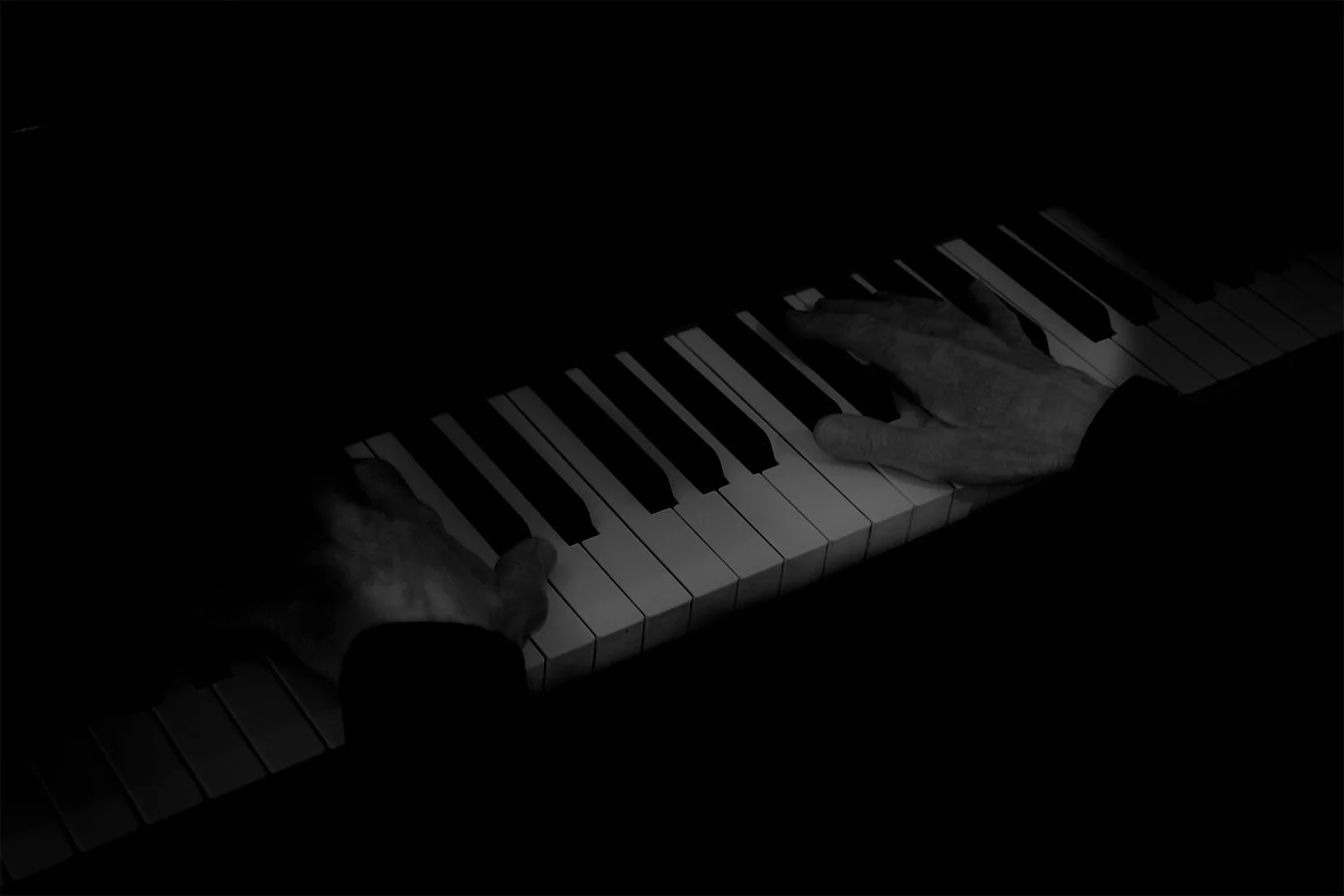
I was once invited by my business partner to a retreat he was leading with executives of a West Coast hospital system. At a moment when the hundred or so people in the room were at a stalemate, my partner invited me to improvise on the piano both the turmoil surfaced in their conversation as well as the "heartbeat" of the hospital's mission.
After I played, a blanket of silence fell upon the room. And then a woman stood up and said, "I remember now why I was drawn to the healthcare profession in the first place. Let's begin this difficult conversation again."
Like the deer at the edge of the forest, she longed to take a step closer. The risk she took made all the difference.
You Darkness
It was with our touch that we respectfully entered into unknown, uncharted territory together…
It was with our touch that we respectfully entered into unknown, uncharted territory together.
You stared at me with those hazel eyes pleading for a solution. I didn’t have one for you. I had just come home and found you in tears. Your prognosis was in months now. It didn’t seem fair. But facing death at any age never seems fair. All I could do was reach out my hand to yours. Our hands touched. First our fingers, then our fingers entwined into contact with our palms.
It was with our touch that we respectfully entered into unknown, uncharted territory, together, discovering that darkness can be an ally.
You darkness from which I come,
I love you more than all the fires
that fence out the world,
for the fire makes a circle
for everyone
so that no one sees you anymore.
But darkness holds it all:
the shape and the flame,
the animal and myself,
how it holds them,
all powers, all sight—
and it is possible: its great strength
is breaking into my body.
I have faith in the night.
Rainer Maria RilkeTrans. D.W.
The Beautiful One
“The Beautiful One” is inspired by Rumi's poem called “Open the Window of Your Heart” in company with the profundity of “being held” by a horse during an equine leadership program on a ranch in West Marin, California…
“The Beautiful One” is inspired by Rumi's poem called “Open the Window of Your Heart” in company with the profundity of “being held” by a horse during an equine leadership program on a ranch in West Marin, California.
Do not worry if our harp breaks
Thousands more will appear.
We have fallen in the arms of love where all is music
If all the harps in the world were burned down,
Still inside the heart
There will be hidden music playing.
Do not worry if all the candles in the world flicker and die
We have sparks that start the fire.
The songs we sing
Are like foam on the surface of the sea of being
While the precious gems lie deep beneath.
But the tenderness in our songs
Is a reflection of what is hidden in the depths.
Stop the flow of your words,
Open the window of your heart and
Let the spirit speak.
This is what you told me that hot, dry summer day with the eyes of others upon us, gently holding us with their gaze of attention and care. Both human and animal alike. When it comes to matters of the heart every living creature is involved, understanding the pulls, the twists, the hopes, aspirations and longings that remain in motion deep within the recesses of the heart.
I lay my head upon your body. I could feel your slow and even inhalation and exhalation. They say that all time can stand still. And now I truly believe it. And I understood then that time not only stands still but time expands and contracts, just as the slow, steady pace of your breathing. And within every inhale arises worlds remembered, forgotten, and with every exhale the release of worlds wishing to be gently placed into the larger space of what holds us all in our beloved universe.
With all those who have come and gone, with all those I have known through the chambers of my heart, they seemed to have been with us that hot, dry summer day. When I lay my head on the side of your body where your enormous heart resides, I surrendered. You held me in such a way that I knew I could melt, could open to the tenderness of my song which is your song which is all of earth’s song, all of this world’s song, all of the beauty and suffering that we all know so horribly and wonderfully.
And after I cried an eternity of tears, you were still here, still present. And you placed your head on my shoulder, nuzzling me, moving around my face and over to my other shoulder, as if I were your colt, your young one. And I too felt this way. Young and innocent.
And then and there, I thanked you. I thanked you for your graciousness and strength.
And I carry the openness of my own heart into places that are deserving. No more. No less. Can it be this simple? This falling into love where all is music.
I Vow
“I Vow” is a musical statement from when I closed one chapter of my life, opening myself to many other chapters…
“I Vow” is a musical statement from when I closed one chapter of my life, opening myself to many other chapters.
I had been wrestling with how to leave a music director position that was no longer satisfying. I kept shaking my head and saying, “This is what I know. I know this life of service from the inside out. I do my job well, and am recognized for my contributions. Isn’t this enough?” It wasn’t enough. This slow-growing disturbance became a vow to say “no” to what was no longer alive within me, making room for saying “yes” to resonant places to be cultivated. This piece was performed once in a group of leaders who were facing similar dilemmas, and that performance allowed for an exploration of their similarly emerging inclinations. For me, simply composing it had opened possibilities for the immediate and far-ranging future.
Anyone Can Sing
Over the years, I have seen many people find a voice for their soul through song. In my volunteer and nonprofit work, I have had the privilege of guiding many who are healing with cancer, or facing death and loss, through a cathartic process of song-making…
Over the years, I have seen many people find a voice for their soul through song. In my volunteer and nonprofit work, I have had the privilege of guiding many who are healing with cancer, or facing death and loss, through a cathartic process of song-making. My memories of these experiences resonate with this poem by William Ayot, after which this piece is named:
Anyone Can Sing by William Ayot
Anyone can sing. You just open your mouth,
and give shape to a sound. Anyone can sing.
What is harder, is to proclaim the soul,
to initiate a wild and necessary deepening:
to give the voice broad, sonorous wings
of solitude, grief, and celebration,
to fill the body with the echoes of voices
lost long ago to bravery, and silence,
to prise the reluctant heart wide open,
to witness defeat, to suffer contempt,
to shrink, lose face, go down in ignominy,
to retreat to the last dark hiding-place
where the tattered remnants of your pride
still gather themselves around your nakedness,
to know these rags as your only protection
and yet still open—to face the possibility
that your innermost core may hold nothing at all,
and to sing from that—to fill the void
with every hurt, every harm, every hard-won joy
that staves off death yet honours its coming,
to sing both full and utterly empty,
alone and conjoined, exiled and at home,
to sing what people feel most keenly
yet never acknowledge until you sing it.
Anyone can sing. Yes. Anyone can sing.
Clementine’s Song
Clementine came to my studio when she was only eight years old. She and her mother often held hands and kissed good-bye, then Clementine would quietly enter, whisper hello, and sit down on the piano bench…
Clementine came to my studio when she was only eight years old. She and her mother often held hands and kissed good-bye, then Clementine would quietly enter, whisper hello, and sit down on the piano bench.
She was one of those students who I never “taught.” I might have guided her, but her natural ability with music allowed quick learning, the easy interpretation of pieces, and improvisations that originated in her fertile imagination. When she improvised, I could always hear her signature sound. This sound matched the way her entire body emoted. She looked like a waving palm tree in the warm breeze of a tropical climate. No effort. All flow. “Clementine's Song” incorporates a piece that she improvised when she was 10 years old. I recorded it and later morphed it through software, adding cello and my own piano playing. It became one piece in a larger show called Listening Between the Worlds. The show begins with this evocative question: How might your life have been different—once when you were somewhat older than young, struggling to fulfill what you thought ought to be done—if you had slowly walked away from the noise crowding in on you until you heard, from within yourself, a silence you had almost forgotten? As a child, Clementine lived in this world of timelessness where the imagination gives rise to new possibilities. I will be forever grateful to her for this reminder.
Hearthfire
The concert organist is a rare and dying breed—and my original training. Organ is the precursor to synthesizers and the complex and multilayered sounds that are now easily accessible through technology…
The concert organist is a rare and dying breed—and my original training. Organ is the precursor to synthesizers and the complex and multilayered sounds that are now easily accessible through technology.
When we organists were in the mainstream, we played in churches as disembodied angels, and for silent films, often horror. Just as we can feel distanced from loved ones, physically or emotionally, when I first played organ I felt a longing to connect more directly with the listeners. I thus attempted to change that listening perspective, leaning toward our humanity rather than playing as if from a distant loft. “Hearthfire” is one such example. It follows a simple ostinato pattern with variations, evoking this sense of longing but also abiding, no matter what the circumstance. It is named after a poem by Gary Diggins, which evocatively explores similar themes. One of the first times I played this piece, a teenager walked up to me to say how much she loved it. In her late twenties, this young woman died of cancer. I dedicate this piece to her.