
The Audio Blog
Listen to a composition while reading a story that lives within it.
Josie’s Song
Josie walks tentatively into the music studio. This is our first session together. “Hi, Josie! I’m Maryliz. Come on over to the piano and sit with me, okay?” Without a word, this slender nine-year-old girl walks over and slowly slides herself onto the bench…
Josie walks tentatively into the music studio. This is our first session together.
“Hi, Josie! I’m Maryliz. Come on over to the piano and sit with me, okay?”
Without a word, this slender nine-year-old girl walks over and slowly slides herself onto the bench.
“This bench can move up and down. Check it out,” I say to her.
She takes the handles on either side of the bench and turns them in one direction. The bench rises. Her petite body slowly ascends.
“Wow,” she whispers under her breath, as she begins to make sense of her surroundings.
“Let’s make up a song,” I suggest. “If you place your fingers like this on the black keys, I’ll play on these black keys on the other side of you.” She takes in the landscape I’ve described. “Ready?” She nods.
I begin with a steady rhythm. She places one finger on a single key. Her eyes are as big as saucers. She proceeds with another key, and another finger. She doesn’t rush. And yet she doesn’t hesitate. Another key. Another finger. A slow build. Until she is playing with all ten digits, her body swaying with the gentle rhythm. She is navigating the territory of improvisation in her own style, following a sound, experimenting, engaging, discovering, and creating a well-structured piece. The music is as beautiful as the opportunity to bear witness.
In those few moments, Josie taught me about pacing. If I ever get out in front of myself, I return to this piece, her improvisation. I am reminded to honor my own pace and to follow the rhythm and flow of what is naturally emerging.
This is one of Josie’s many improvisations that I recorded, arranged and performed with my colleague and friend, cellist Ari Barnes.
Find this composition on Spotify, Apple Music, YouTube, and other music platforms.
These Hands
We haven’t seen one another for a few years. The two of us are sitting at my kitchen table, catching up on the significant moments we are eager to share. I glance down to collect my thoughts…
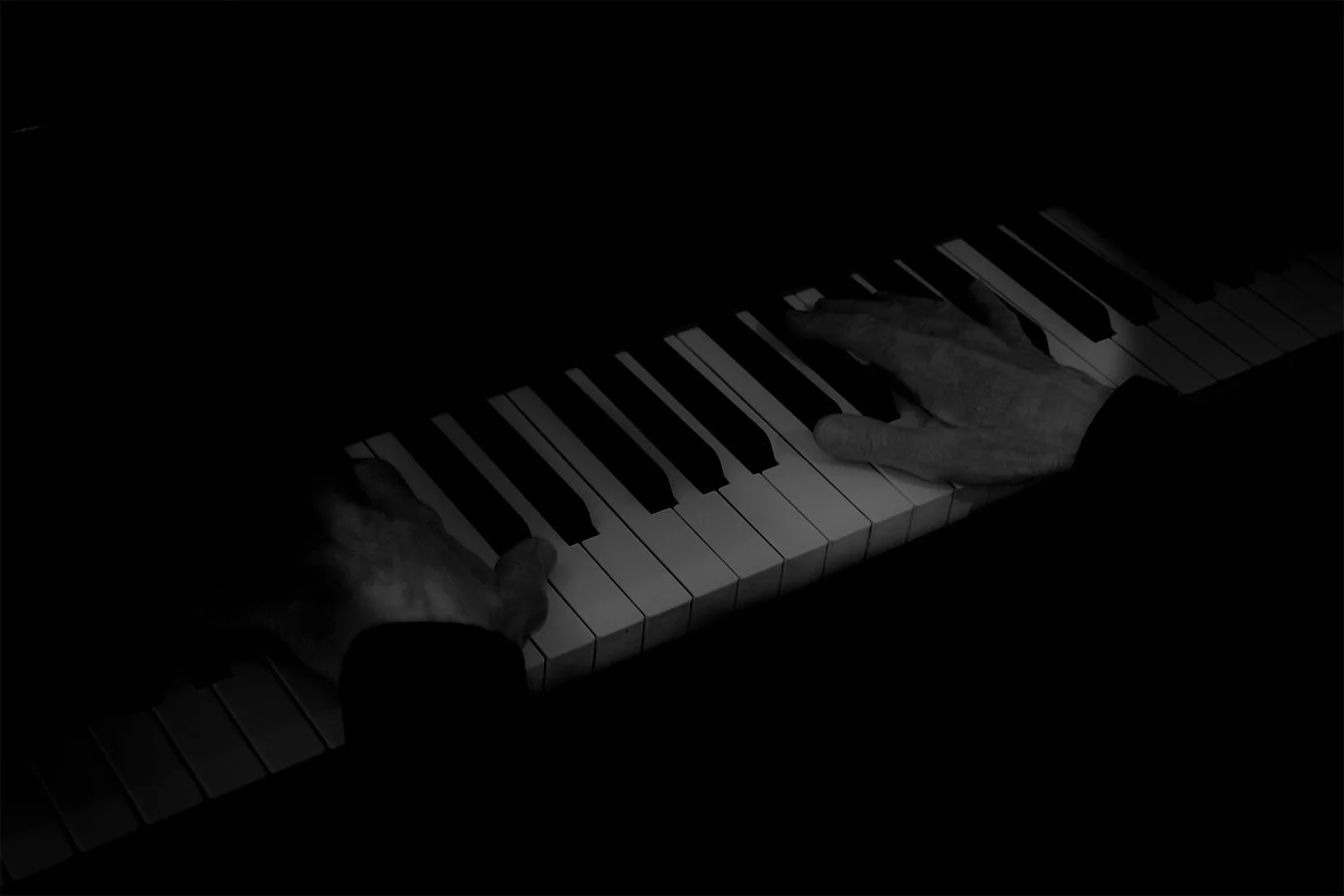
We haven’t seen one another for a few years. The two of us are sitting at my kitchen table, catching up on the significant moments we are eager to share. I glance down to collect my thoughts. My eyes are drawn to his hands, one placed gently on top of the other. I gaze at my own hands, one placed gently on top of the other, only a few inches away from his.
In that moment, I understand the genetic code. I don’t need years of study or research to know that my lineage is part of his. I reach out and place our hands together.
“Look, Dad. The age marks on our hands have similar patterns!” I chuckle, as we compare our two left hands. “How about the right?” I invite, playfully. And surprise, surprise, they match too.
For years his hands grabbed ahold of the gears in a 180 Cessna airplane as he flew into African villages to transport individuals needing medical care. Africans called him Uwandji Omadjela. Chief Hawk.
Years later I placed my hands on a piano and learned to transport individuals into the universal language of music with similar intensity.
Even though you died many years ago, you are still with me, Dad. On this day, I say to you: “Kutshu la wulu, Uwandji Omadjela.” Go in strength, Chief Hawk.
And I can hear you say, “Kutshu kali la wulu.” Stay in strength, dear daughter.
Mother and Child
Tip of the paddle slipping into the water. Pulling back against the ocean current. Kayak moving forward. Paddle out, up, around, in. Pulling back, out, up, around, in. The motion is hypnotic…
Tip of the paddle slipping into the water. Pulling back against the ocean current. Kayak moving forward. Paddle out, up, around, in. Pulling back, out, up, around, in. The motion is hypnotic.
I rest my paddle on the rim of the boat, while the undulating ocean waves cradle me with their movement. I look out on the horizon, and yes, I see them.
Their dark bodies are slipping into the water with a choreographed motion they have never needed to rehearse. A long pause and there they are again. Bodies rise out of the water and gracefully return to the ocean. Like the paddle. Out, up, around, in. Their deep exhales spraying water like geysers as they surface once again.
They are much closer now. I keep my kayak at a respectful distance. It’s a mother and her calf. I can actually hear their exhales each time one of them surfaces. The mother’s breath is deep and slow. The calf’s is high and quick. They remain in the same general area, as if this is their oceanic backyard.
Their relationship taps into a universal one of mothers with their children. To this day they remain with me. So simple. So true to the birthright of all living beings on our earth.
Kelly’s Song
I composed this song as a musical manifestation of Kelly herself. The idea of composing songs for friends and colleagues was seeded in me by Eduard Elgar’s Enigma Variations…
I composed this song as a musical manifestation of Kelly herself. The idea of composing songs for friends and colleagues was seeded in me by Eduard Elgar’s Enigma Variations. These compositions have intrigued me for most of my musical career. The story goes that simply for fun Elgar began toying with a tune on the piano, adapting it to make musical caricatures of some of his friends.
Each variation in the orchestral piece that originated from this “doodling” is headed by the initials of the friend portrayed, beginning with “C.A.E.” (Elgar’s wife, Caroline Alice) and closing with “E.D.U.” (Variation XIV), a self-portrait of the composer.
A similar creative impulse began to stir in me a few years back. Now, on occasion, I’ll anticipate a friend’s birthday, sit down at the piano, reflect on this person, and improvise what I deem to be his or her essential nature. This turns into a composition and a recording I give to the recipient. I have discovered over the years that reflecting on the distinct way a person shows up in this world and capturing this musically is just as much a gift to me as it hopefully is to the recipient.
When I think of Kelly, I think of the distinct way this beautiful woman exudes kindness and generosity and her way of speaking forthrightly to her circle of friends and family. Perhaps you can hear it.
Thank you, Kelly.
Find this composition on Spotify, Apple Music, and other music platforms.
A Beautiful Dark Song
“What’s going on?” I ask her, with concern in my voice. “I’m going down again,” she says, looking at me with tired eyes. “Where is ‘down’?” I inquire…
“What’s going on?” I ask her, with concern in my voice.
“I’m going down again,” she says, looking at me with tired eyes.
“Where is ‘down’?” I inquire.
“I’m not sure,” she says. “I just know that I’m losing hope.”
I slowly nod as she settles under the covers.
I sit quietly beside her bed as day slips into night.
In the dark, listening to her steady breathing, I wonder:
What if this darkness could be her place to safely incubate.
What if this darkness could be her home tonight.
What if in darkness she found the courage to let go of what does not belong to her, pulling close only that which does.
I close my eyes and slip down into this beautiful darkness, following her lead.
What if… What if…
Find this composition on Spotify, Apple Music, and other music platforms.
A Song for the UnSung
I gasped when he slipped on that patch of ice on the hiking trail. His body flipped in the air like a gymnast achieving an impossible feat…
I gasped when he slipped on that patch of ice on the hiking trail. His body flipped in the air like a gymnast achieving an impossible feat. Unlike a gymnast, he landed directly on his hip. The one that had been replaced a few months prior. In an instant, we are nowhere but together in this moment.
We lock eyes; we both know the accident is serious.
We manage to find a way for him to lie in my lap. He is shivering more from shock than cold.
“How do I get help?” I scream inside myself. I am supporting his torso while he is squirming in pain.
At the top of the hill, I see a young man.
“Down here,” I yell.
He picks up his pace.
As he comes closer, peering down at us, he instructs, “Don’t move.”
I look up at the trail a second time. A young woman walks as fast as she can down the path, comes behind me, and wraps her arms around both of us awkwardly because of the steep incline on either side of the trail. It didn’t matter how awkward it was. It felt like a soothing balm.
“What happened?” she asks.
“He fell on that ice.” I point at it with my trembling finger.
“Call the ambulance, honey,” the man says deliberately and slowly to his companion.
“Will do,” she says, as she pulls out her phone from her back pocket.
Minutes feel like hours.
The young couple carves out a safe area on the trail as other hikers come along and attempt to gawk.
“Keep going, please. We’ve got this. Help is on the way.”
Five paramedics show up, lift him gently onto a stretcher and take him down the side of the steep hill, slipping and sliding as they go.
The three of us follow behind.
I am riveted on the medical team as they lift the stretcher up and into the back of the ambulance.
“You’ll have to follow behind,” a middle-aged woman commands.
“Okay,” I respond.
I turn around to thank the guardian angels from the trail.
They are nowhere to be seen.
Now months later, I want to say this to them, whoever and wherever they are:
I don’t know how to thank you. I don’t know your names. I don’t know where you live. I don’t know anything about you, and yet I know everything about you because of how you ran towards us, not away from us.
This is my song for you.
Whoever listens to this song, I invite you to sing to the unsung in your own lives. There are so many unsung heroes in the fabric of our global story.
Find this composition on Spotify, Apple Music, and other music platforms.
Choices
This is dedicated to all of us who make difficult choices in our lives—the choices we don’t want to make but know must be made…
This is dedicated to all of us who make difficult choices in our lives—the choices we don’t want to make but know must be made.
May these sounds be like a benediction, for bowing our heads to the many revelatory choices that lead us in one direction or another.
The Divining Rod
He was a prominent citizen. He had influenced hundreds if not thousands of people. He was like a divining rod, one of the exceptional ones who can find water with a two-pronged stick…
He was a prominent citizen. He had influenced hundreds if not thousands of people. He was like a divining rod, one of the exceptional ones who can find water with a two-pronged stick.
People around me confided, “I am not ready for him to go. He still has more to contribute.”
A few weeks before he died, he confided in me as well.
He said, “I am afraid of choking.” I listened.
He said, “I am afraid of dying of asphyxiation.” I listened.
He said, “Help me.” I listened.
I said, “When you feel my hand on your chest, we will breathe together.”
I placed my hand on his chest. We practiced breathing together. With each inhale and exhale, we rehearsed his dying.
Now, at the time of his death, I am a midwife to his process. I request those who are frightened, those who are holding on to his life, to leave the room. Two of us remain, sitting on either side of him.
Helplessness floods my being, and then just as swiftly I find myself fully engaged with him, as he is now—and as I am now.
He says, “I am afraid of choking.” I listen.
He says, “I am afraid of dying of asphyxiation.” I listen.
He says, “Help me.” I listen.
And I say, “When you feel my hand on your chest, we will breathe together.”
And so we breathe once more, as one, my hand gently upon his chest.
And as he takes his last breath, an immense and tender rush fills the room. And I hear myself say, “Help me.” And in my imagination I hear him say, “When you feel my hand on your chest, we will breathe together.”
Becoming an Art Form
Our quarterly ELIA Dojo is under way. I am sitting on a comfy couch surrounded by colleagues—some new to the Studio, others well versed…
Our quarterly ELIA Dojo is under way. I am sitting on a comfy couch surrounded by colleagues—some new to these “dojo-style” leadership workshops, others well versed. The ELIA Dojo is a space for us to come with challenges at significant times in our lives. We have all come to realize that these challenges are thresholds; how we respond influences how life unfolds on the other side. We are here to support one another.
Our intimate group is listening to a young woman who has been grappling with how to conduct a crucial conversation with her business partner, a conversation that has the potential to change her future. She has described the issue, the tension in their relationship, and begins practicing different ways to converse. Her partner is not in the room; we are running a simulated conversation for their future encounter. The rest of us listen, taking note of what we each see as potential breakthroughs or subtle shifts possible for an optimal outcome between them. We each find a moment to contribute our unique perspective, until our shared understanding of the issue has evolved into a multifaceted jewel.
This particular simulation inspired me to consider the ELIA process through the composition of a fugue. This type of music writing is a precise compositional form. The architectural design is balanced and symmetrical while creating a jewel in its own way. A theme, called a subject, is introduced. This is like when the young woman presents her issue and begins her simulation. Once the subject has been stated, that same subject enters again but in another voice, in another melodic range. The effect is a duet using the same theme. Thus begins the inquiry in this ELIA space. A third voice appears, iterating the same subject in yet another range. It now becomes a trio. Every time the subject is restated, another dimension appears. The multifaceted jewel results from the integrity of the three voices that become the piece of music.
Over and over again in these workshops, I witness the integrity of each person’s voice as it contributes to the understanding of the issue at hand. By the end of a day’s workout, we have become an art form. It is a breathtaking experience!
I believe our future rests on such collectives—on our capacity to reveal the many dimensions of possibility and perspective in what otherwise appear as obstacles in our path. The outcome is an extraordinary testimony to collaboration at its best.
The Embrace
I close my eyes. Yes, I hear it. The steady rhythm of the ocean waves just beyond the beach house. I pause. I slow down my breathing. I notice my quickening heartbeat. I am stepping into vulnerable territory…
I close my eyes. Yes, I hear it. The steady rhythm of the ocean waves just beyond the beach house. I pause. I slow down my breathing. I notice my quickening heartbeat. I am stepping into vulnerable territory.
I am about to introduce a new piece of music to our latest cohort of ELIA: a radical and beautiful ten-month learning lab for deepening one’s leadership and capacity to influence change. I feel raw whenever I introduce new music. It is like presenting a newborn. This particular piece was inspired by this group of twelve, and this is our last evening after nearly a year together. It is a poignant moment. We have engaged in deep work with one another. We have drawn out the latent intelligence that resides in our emotional and somatic selves. I have fallen in love with each one of these leaders, and with the heart of the group.
Slowly, I open my eyes, turn to the group, and explain, “This piece is called The Embrace. It expresses holding and being held, just as we have done in this community, supporting each other in being the best we can be in challenging situations. My left hand plays the lower register of the music—a steady rhythm that holds and receives the upper register of my right hand. This steady rhythm is the presence we have honed within ourselves—the capacity to hold steady in intense situations, shifting quickly from a reactive state to a resourceful one. It is also the steadiness we have provided for each other throughout the practicing, simulations, vulnerability, and risk of bringing our leadership to a new level.”
I pause and take a breath, then continue to unfold the metaphor.
“This right-hand melody carries improvisational phrases full of surprise because of the predictability of my left hand. It is an apt metaphor for how the steadiness growing within and between us creates the conditions for greater innovation and experimentation, and then for testing those ideas. When I improvise the top line, the feeling of exhilaration comes through discovery, of unexpected turns, of playful contradictions—all because my left hand holds true to the pattern established.”
I pause before I begin the piece. I reflect for a moment in this pause, considering how we have built a strong container for just this occasion. And I think to myself that true resilience is vulnerability. With vulnerability comes aliveness. With aliveness comes an ability to respond. To the music. To what life brings. To those that hold us as we grow.
I hear the ocean waves as my fingers touch the keys. I wouldn’t want to be anywhere but right here, I say to myself.
Beyond Ideas
I am at a military ceremony, awkwardly but willingly. I respond to the crescendo from the loudspeaker in the stadium by standing, clapping, and shouting along with the crowd, listening to the rousing patriotic, symphonic march…
I am at a military ceremony, awkwardly but willingly.
I respond to the crescendo from the loudspeaker in the stadium by standing, clapping, and shouting along with the crowd, listening to the rousing patriotic, symphonic march. Out of the forest and onto the open field, as theatrical smoke and fog fade, the battalion walks in measured tread in their graduation regalia.
“Where are you?” I ask myself as I scan the troops, my heart pounding.
We are held in suspense as they march by us, a blank gaze from their faces and perfect synchronicity in their steps. They halt and turn toward us. The loudspeaker barks, “You may now greet your soldier on the field.”
I want to run to my stepson, both to congratulate him for making it through bootcamp, and to make sure he is still intact.
Still now, back at home, I wrestle with accepting his decision to join the army. I hold the tension of my own bias in comparison to his. I reach for an excerpt from a Rumi poem. Like a mantra, I repeat it:
Out beyond ideas of wrongdoing and rightdoing,
there is a field. I'll meet you there.
When the soul lies down in that grass,
the world is too full to talk about.
Ideas, language, even the phrase each other
doesn't make any sense.
The breeze at dawn has secrets to tell you.
Don’t go back to sleep.
You must ask for what you really want.
Don’t go back to sleep.
People are going back and forth across the doorsill
where the two worlds touch.
The door is round and open.
Don’t go back to sleep.
Excerpt from “A Great Wagon” by Rumi
Different phrases carry emphasis each time I whisper it, feeling the sensations of the words on my lips. I place my fingers on the piano keys. “Here is the state I will reside in each time I greet you, my son. I am willing to listen from this place, to be open to you. I won’t go back to sleep. I promise.” My fingers move across the keys, and I play my promise.
Dismissal
Sometimes our life force intensifies close to an important threshold. Staying steady while using this surge of energy is crucial. I recall such a moment in my life that changed everything…
Sometimes our life force intensifies close to an important threshold. Staying steady while using this surge of energy is crucial. I recall such a moment in my life that changed everything.
A person who is my mentor leans over and whispers, “You know, improvisation is the ultimate in your art form.” I nod in agreement. Of course, I have never attempted improvisation in my life, being a classically trained musician where every note is respected on the score with no deviation whatsoever. Little do I know that with this simple nod, in the not-too-distant future, comes a waterfall of trepidation, experimentation, and rewiring of my most fundamental ways of relating to music.
The first time I try “it,” that is improvising in public, it is terrifying. And… I try it. A few notes deviate from the score. Quickly, I return to home base. That is enough. Next time, I deviate from the score a few seconds longer, adjusting to the degree of exposure I feel. And another time, I stretch the length out to as much as I can stand, and then return to home base but not as quickly as in previous attempts.
And so it goes for months, this practice, testing, discerning, until one day I play without any score. I cross the threshold. I play in direct contact with the audience. I play their field of response as I return the conversation with my reactions and musical comments.
Fear turns to exhilaration. And with that surge comes a wellspring of gratitude for my mentor who gently “dismissed” me from my classical study and opened the door to the next chapter of my musical life.
Now through my work and music, I have the privilege of witnessing moments like this with people from many backgrounds as they face fundamental thresholds in both their personal and professional lives.
The Deer
I have a photograph on my desk that I contemplate daily. A doe is peering through a winter forest of bare trees, gazing at me. I imagine myself in a meadow returning her innocent and watchful stare…
I have a photograph on my desk that I contemplate daily. A doe is peering through a winter forest of bare trees, gazing at me. I imagine myself in a meadow returning her innocent and watchful stare.
She is on alert, now that she has seen me. I imagine her saying to herself, "Should I move closer? I would like to be in the open meadow, but is it safe? Is this human safe?"
I was once invited by my business partner to a retreat he was leading with executives of a West Coast hospital system. At a moment when the hundred or so people in the room were at a stalemate, my partner invited me to improvise on the piano both the turmoil surfaced in their conversation as well as the "heartbeat" of the hospital's mission.
After I played, a blanket of silence fell upon the room. And then a woman stood up and said, "I remember now why I was drawn to the healthcare profession in the first place. Let's begin this difficult conversation again."
Like the deer at the edge of the forest, she longed to take a step closer. The risk she took made all the difference.
You Darkness
It was with our touch that we respectfully entered into unknown, uncharted territory together…
It was with our touch that we respectfully entered into unknown, uncharted territory together.
You stared at me with those hazel eyes pleading for a solution. I didn’t have one for you. I had just come home and found you in tears. Your prognosis was in months now. It didn’t seem fair. But facing death at any age never seems fair. All I could do was reach out my hand to yours. Our hands touched. First our fingers, then our fingers entwined into contact with our palms.
It was with our touch that we respectfully entered into unknown, uncharted territory, together, discovering that darkness can be an ally.
You darkness from which I come,
I love you more than all the fires
that fence out the world,
for the fire makes a circle
for everyone
so that no one sees you anymore.
But darkness holds it all:
the shape and the flame,
the animal and myself,
how it holds them,
all powers, all sight—
and it is possible: its great strength
is breaking into my body.
I have faith in the night.
Rainer Maria RilkeTrans. D.W.
The Beautiful One
“The Beautiful One” is inspired by Rumi's poem called “Open the Window of Your Heart” in company with the profundity of “being held” by a horse during an equine leadership program on a ranch in West Marin, California…
“The Beautiful One” is inspired by Rumi's poem called “Open the Window of Your Heart” in company with the profundity of “being held” by a horse during an equine leadership program on a ranch in West Marin, California.
Do not worry if our harp breaks
Thousands more will appear.
We have fallen in the arms of love where all is music
If all the harps in the world were burned down,
Still inside the heart
There will be hidden music playing.
Do not worry if all the candles in the world flicker and die
We have sparks that start the fire.
The songs we sing
Are like foam on the surface of the sea of being
While the precious gems lie deep beneath.
But the tenderness in our songs
Is a reflection of what is hidden in the depths.
Stop the flow of your words,
Open the window of your heart and
Let the spirit speak.
This is what you told me that hot, dry summer day with the eyes of others upon us, gently holding us with their gaze of attention and care. Both human and animal alike. When it comes to matters of the heart every living creature is involved, understanding the pulls, the twists, the hopes, aspirations and longings that remain in motion deep within the recesses of the heart.
I lay my head upon your body. I could feel your slow and even inhalation and exhalation. They say that all time can stand still. And now I truly believe it. And I understood then that time not only stands still but time expands and contracts, just as the slow, steady pace of your breathing. And within every inhale arises worlds remembered, forgotten, and with every exhale the release of worlds wishing to be gently placed into the larger space of what holds us all in our beloved universe.
With all those who have come and gone, with all those I have known through the chambers of my heart, they seemed to have been with us that hot, dry summer day. When I lay my head on the side of your body where your enormous heart resides, I surrendered. You held me in such a way that I knew I could melt, could open to the tenderness of my song which is your song which is all of earth’s song, all of this world’s song, all of the beauty and suffering that we all know so horribly and wonderfully.
And after I cried an eternity of tears, you were still here, still present. And you placed your head on my shoulder, nuzzling me, moving around my face and over to my other shoulder, as if I were your colt, your young one. And I too felt this way. Young and innocent.
And then and there, I thanked you. I thanked you for your graciousness and strength.
And I carry the openness of my own heart into places that are deserving. No more. No less. Can it be this simple? This falling into love where all is music.
I Vow
“I Vow” is a musical statement from when I closed one chapter of my life, opening myself to many other chapters…
“I Vow” is a musical statement from when I closed one chapter of my life, opening myself to many other chapters.
I had been wrestling with how to leave a music director position that was no longer satisfying. I kept shaking my head and saying, “This is what I know. I know this life of service from the inside out. I do my job well, and am recognized for my contributions. Isn’t this enough?” It wasn’t enough. This slow-growing disturbance became a vow to say “no” to what was no longer alive within me, making room for saying “yes” to resonant places to be cultivated. This piece was performed once in a group of leaders who were facing similar dilemmas, and that performance allowed for an exploration of their similarly emerging inclinations. For me, simply composing it had opened possibilities for the immediate and far-ranging future.
Anyone Can Sing
Over the years, I have seen many people find a voice for their soul through song. In my volunteer and nonprofit work, I have had the privilege of guiding many who are healing with cancer, or facing death and loss, through a cathartic process of song-making…
Over the years, I have seen many people find a voice for their soul through song. In my volunteer and nonprofit work, I have had the privilege of guiding many who are healing with cancer, or facing death and loss, through a cathartic process of song-making. My memories of these experiences resonate with this poem by William Ayot, after which this piece is named:
Anyone Can Sing by William Ayot
Anyone can sing. You just open your mouth,
and give shape to a sound. Anyone can sing.
What is harder, is to proclaim the soul,
to initiate a wild and necessary deepening:
to give the voice broad, sonorous wings
of solitude, grief, and celebration,
to fill the body with the echoes of voices
lost long ago to bravery, and silence,
to prise the reluctant heart wide open,
to witness defeat, to suffer contempt,
to shrink, lose face, go down in ignominy,
to retreat to the last dark hiding-place
where the tattered remnants of your pride
still gather themselves around your nakedness,
to know these rags as your only protection
and yet still open—to face the possibility
that your innermost core may hold nothing at all,
and to sing from that—to fill the void
with every hurt, every harm, every hard-won joy
that staves off death yet honours its coming,
to sing both full and utterly empty,
alone and conjoined, exiled and at home,
to sing what people feel most keenly
yet never acknowledge until you sing it.
Anyone can sing. Yes. Anyone can sing.